Austere, Ultra-Refined “Fatherland” Is Mother’s Milk To Smarthouse Mavens

As expected, Pawel Pawlikowski‘s Fatherland, which I caught late yesterday afternoon, is an austere masterwork. Damn near perfect in every respect, it immediately struck me as a Palme d’Or winner waiting to happen. Spare and precise and honed to the bone, Fatherland runs only 82 minutes…a thrilling discipline!

The performances are equally spare, if not more so. Sandra Huller is being touted (and will continue to be touted) as a Best Actress Oscar contender, but she plays it very close to the vest, as in “very“. The German actress has two scenes in which she lets loose with emotional frustration and unleashed grief over the shocking suicide of her brother Klaus (August Diehl), but that’s it. The rest of her performance is subdued to the max, and yet the reality of her core situation sinks right in. Full exposure.

A 1949 road movie about the great Thomas Mann (Hanns Zischler) and his daughter Erika (Huller) travelling through a divided Germany for a Goethe celebration in the city of Weimar, Fatherland is about as narratively fat-free as a smarthouse feature (or even a popcorn flick) could possibly be.

Translation: Everything that needs to be said or understood is fully conveyed by Fatherland, although some of the HE rubes will probably complain “there’s not enough meat on the bone!” To which I say “there’s enough meat here, trust me…quality, not quantity…nutrition, nutrition.”

It was principally shot, of course, by Pawlikowski’s longtime collaborator Lukasz Zal with the usual needle-sharp monochrome palette — deep blacks, lush grays, ravishing silvertones — within a boxy 1.37:1 aspect ratio.

Fatherland is immaculate and exquisite, and is particularly admirable for the subtlety deployed at every turn. Plot advancements and historical underpinnings are never hammered home — it’s all played deftly and solemnly…fine period detail, a fascinating “you’re really there” aesthetic.

One of my favorite scenes is nominally of little consequence, and yet feels like a perfect brushstroke. Thomas and Erika are stopped — idling — at an East German border crossing. A young soldier, presumably unaware of the elder Mann’s status, taps on a rear passenger window and asks, by way of a slight gesture, if Thomas could spare a cigarette. The author rolls down the window and offers the lad one of his smallish cigars. Not a word, not a wink…a slight hint of disdain.

I’m sorry but I liked Fatherland so much that I’m leaving now to catch it a second time at an 8:30 am Grand Lumiere screening.

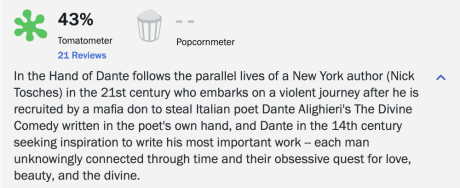
Farhadi’s Talky “Parallel Lives” Is, For Me, A Fascinating, Brilliantly Woven Metaphor for Sometimes Manipulative Creative Process

HE to critic friend after 6:45 pm screening of Asghar Farhadi’s Parallel Lives: “So whadja think?”

Critic friend to HE: (Making thumbs-down gesture) “Boring. Totally bored. Too long.”

HE: “But it’s a really honest examination of what writers do, I thought…an exercise in naked self-portraiture. An admission that writers do whatever the fuck they can — imagine anything, steal ideas, stalk women, use others, play dishonest emotional games — in order to create a good story or write a good screenplay. Farhadi is admitting ‘this is who I am, what I am.’ And in this sense, it’s really bold.”

Critic friend: “It’s boring. All apartment interiors, two or three cafe scenes, two Paris Metro scenes…all talk. I kept wanting it to end, and time and again it refused to.”

HE: “I realize it’s visually self-limiting because it’s almost all dialogue, but I wasn’t bored at all. I was totally hooked because it’s kind of Rear Window-ish, and because it keeps you guessing as to where the narrative is going.”

Critic: “Great. Good for you.”

HE: “Too much dialogue? What were you looking for, a car chase or something?”

Critic: “I’m just tired of films that are basically just MCUs of people talking and talking. Cinema is changing. I want more than just dialogue.”

HE: “You’re tired of dialogue? God, you sound like a video game guy!”

Critic: “I was bored…sorry. I wanted more.”

I’m almost all alone on this one. Almost everyone I’ve read or spoken to disagrees. The dismissal of this obviously different, indisputedly ambitious, unusually told tale of serpentine plot threads, switching narratives, covert agendas and discreet fake-outs is unmistakable.

When the credits began rolling at the end of Thursday night’s Salle Debussy screening, faint clapping could be heard but the sound of ominous silence easily dominated.

I’m not saying the naysayers are wrong, but they seem to be ignoring the self-portraiture aspect. Farhadi cast Adam Bessa, a 34-year-old French-Tunisian actor who bears a certain resemblance to Farhadi, as Adam, the film’s central protagonist / instigator. It’s not a stretch to regard Bessa as some kind of Farhadi stand-in.

I’ll try to fill in some of the blanks tomorrow, but it’s 12:30 am and I have to attend an 8:30 am screening, not to mention be up and sharp by 6:50 am.

There can be no disagreement that the 49 year-old Virginie Efira is, right now, easily the most fetching, Marilyn Monroe in Some Like It Hot-level, middle-aged actress on the planet earth. Zaftig is beautiful.

It’s a bit disconcerting that costar Vincent Cassel, who will turn 60 this year, is presented by Farhadi as a withered, getting-older guy with aching limbs and thinning hair. In David Cronenberg‘s The Shrouds (’24) he played a silvery hardbod cool cat with a perfect bop haircut. I know it sounds childish to say “I prefer the latter”, but I do.

Argentine Glory

Last night’s Salle Debussy screening of Juan Cabral and Santiago Franco‘s The Match, a highly intelligent, perfectly edited and fully rousing recollection of the 1986 FIFA World Cup match between Argentina and England, was rapturously received, to put it mildly.

I am not a sports hound, of course, and have never, ever watched a soccer game anywhere (pro or amateur), and I adored the second half of this film. (The first half is fine.) I felt truly charged and elated by the wondrous athleticism of the late Diego Maradona…26 when the game was played, 60 when he passed in 2020.

Cabral and Franco cover all the engaging angles and side-stories, step by step including the whole Falklands War backdrop…all of it. Extra-special praise for the editing team of Lucas Coppolechia, Sebastian Fasanelli, Juan Pablo Scaglione and Mauro Caporossi.

I’ve no explanation for having mis-spelled the word “standing.”

Deepest Cavern of Hell

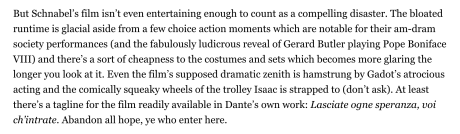
Jane Schoenbrun‘s Teenage Sex and Death at Camp Miasma is an ironically conceived, self-referencing, garbage-level “slasher film” in quotes.

It was shot by Eric Yue with the intention of looking low-rent and generally shitty. It constantly, relentlessly praises the joys and comforts of junk food. I was in hell. I sat there muttering “go fug yahselves, stab yahselves, obliterate yahselves.”

The irony element doesn’t excuse the fact that Teenage Sex and Death at Camp Miasma is essentially a flat, empty, boring serving of spiritually-barren, freeze-dried slasher crap.

It was made to not only tickle and engage the fans (largely the under-45 queer-trans community) but to alienate and anger people like me, and in this respect has clearly succeeded.

I am very, very sorry that I spent 112 minutes in the presence of this hellish creation this morning. Any film from Un Certain Regard is presumed to be challenging or alienating in certain ways, but this…holy effing moley.

It’s essentially a two-hander between Hannah Einbinder (Hacks) as “a young queer filmmaker hired to direct a reboot of the Camp Miasma franchise” blah blah, and poor Gillian Anderson as 50something Billy, a glammy blonde who not only starred in a previous Camp Miasma film but was consumed by the bullshit lore and theology blah blah.

The fact that Eva Victor, whose Sorry Baby I quite admired when I saw it here last year, decided to costar in this thing…it just sends me into a depression pit. Ditto poor Dylan Baker…what are you doing, man?

One idea of a truly agonizing nightmare, I’ve imagined, would be to suddenly find myself in Schoenbrun’s 39-year-old head and body. This would mean, obviously, that I would no longer be an individual, stand-alone dude in a conventional biological or spiritual sense but (gasp!) a “they”. Which, of course, would make me trans and non-binary or, in HE shorthand terminology, a transie.

This might also mean estrangement from the chilly, judgmental straights in my immediate circle, which I don’t believe in — live and let live, I say, It might also mean being “polyamorous with three or more partners”, to quote from Schoenbrun’s Wiki bio. It would also mean being “anti-capitalist” and “an enemy of Zionism and the Israeli genocide of Palestinians,” etc.

I’ll Stick With Grandpa Elia’s Version, Thanks

Zoe Kazan‘s longform Netflix version of John Steinbeck‘s East of Eden will be strikingly different from her grandfather’s 1955 version, which was basically about James Dean‘s anguished Cal Trask.

Zoe’s version adopts the point of view of Jo Van Fleet‘s Cathy Ames/Kate Trask, the bitter, hard-edged madam character who shot Raymond Massey in the shoulder and then, many years later, lent Dean $5K so he could partner with Albert Dekker“s Will Hamilton in the bean business.

I’m simply too attached to Elia Kazan’s 1955 version to give his granddaughter’s angry-feminist version a fair shake.

I respect the fact that Florence Pugh has apparently slimmed down and is no longer chubby-cheeked.

Thursday’s Four Film Marathon

I don’t know about Jane Schoenbrun‘s Teenage Sex and Death at Camp Miasma (Thursday at 8:30 am) or the 1 pm follow-up, Diego Luna‘s Ashes (Niza en la Boca), although reviews of the Luna have been pretty good so far.

But I’m fairly certain that Pawel Pawlikowsky‘s Fatherland (4:45 pm) will be some kind of monochrome smarthouse knockout**, and that Asghar Farhadi‘s Parallel Tales (6:45 pm) will, at the very least, register as moderately impressive.

,/p>

** Sandra Huller‘s performance as Erika Mann, daughter of novelist Thomas Mann (Hanns Zischler), is already being touted as a Best Actress contender. How do I know this? Because Huller will soon be interviewed by THR‘s Scott Feinberg at the Campari Lounge, which is located in “the bunker.”

Imagine The Enveloping Pleasure

…of opening your kitchen window, pushing back the wooden French shutters and looking out at all this effing “waaaahhh“. The apartment is sound-insulated, of course, but just knowing this crap is out there…it’s a bit like living next door to Jurassic Park.

Ballad of a Pink Pelican

Against all odds, the Cannes Film Festival’s press ticketing system gave me a break this morning, abandoning its curious posture of blocking me from reserving a ticket to Kantemir Balagov‘s Butterfly Jam. I was suddenly allowed to attend this morning’s 10 am screening inside the Theatre Croisette (i.e., the basement forum beneath the JW Marriott)…great. Appreciate the largesse!

But no sooner did this happen when the system changed its mind and screwed HE over in a different way, denying me access to Sunday evening’s screening of Maverick, the David Lean documentary. And this was between 7:02 and 7:03 am this morning…thanks so much! I really hate this festival for pulling this shit.

I was surprised that I liked Butterly Jam as much as I did. That’s because it’s a kind of surreal ethnic fable…an oddly poetic, magical-realism thing about Circassian culture and cuisine…the general Circassian diaspora of northern New Jersey. (The 34 year-old Balagov is himself Circassian.) The film is set in and around Newark, New Jersey and Bergen County…God, what a miserable, environment…coarse, gunky, lower-depth vibes.

The central protagonist is Temir (Talha Akdogan), a 16 year-old wrestler with a heavy-set, bordering-on-fat physique, and who bears not the slightest resemblance to his father, Azik (the 33 year-old, warlock-eyed Barry Keohgan). They certainly don’t have the same kind of nose, and Akdogan’s eyes are dark and totally lacking that warlock quality.

Azik’s culinary specialty is “delens,” a traditional meat-and-cheese pie from Russia’s Kabardino-Balkaria region.

Azik’s pet name for his teenaged son is Pyteh, which means “little one.” Azik is a chef working in a struggling Circassian diner in Newark. 36 year-old Riley Keough plays his sister Zalya, the pregnant owner (co-owner?) of the diner.

The inciting incident is Azik being offered a job as top chef at a swanky new restaurant. Better pay, onward and upward, etc. But Azik, being an impulsive ethnic who’s unable to think and act in sensible, practical terms, manages to complicate this situation.

But smart career strategy isn’t the focus here — Jam is a film about all sorts of magical oddball elements by way of Circassian this and that…acne, wrestling, a pink pelican, the lore of Monica Bellucci, etc. Presuming that Butterfly Jam will play commercially in the U.S., I doubt if Joe and Jane Popcorn even know who Bellucci is, much less know her face, especially since she now looks 60ish.

I loved the pink pelican metaphor**, as well as the real bird itself. I didn’t get the acne-healing thing between Temir and real-life wrestler Jaliyah Richards. Keogh, for the first time, looks older than her years — she could easily be 40 or older. Keohgan is playing Temir’s father, as noted, although he looks several years older than 33 with those deeply etched eyebags resting upon his cheekbones. And yet in Sam Mendes‘ currently filming Beatle quartet Keoghan is playing Ringo Starr in his early to mid 20s. Go figure.

** I’m actually not sure what the metaphor actually amounts or alludes to.