Hollywood Elsewhere


  • “Sheep Detective” Soothes, Moves, Placates…Actually Deals With Death

    Catching The Sheep Detectives yesterday afternoon wasn’t my idea — it was a West Orange Sutton detour. It was the first time I’d watched a theatrical film with her. To what extent did this formulaic, family-friendly Agatha Christie thing win Sutton over? She seemed vaguely distracted but not bored or irritated; ditto myself.

    Set in a small, bucolic, storybook English village surrounded by hundreds of acres of hilly grass fields, pic focuses on two communities — the provincial, plodding humans and the timid but secretly English-speaking sheep/rams, one of whom is a regular Miss Marple when it comes to suspecting who’s who and what’s what.

    Hugh Jackman is advertised as the lead, but his English shepherd character is basically a red herring. He’s dead (poisoned) before you know it, and the rest of the film is about Succession‘s Nicholas Braun, playing a flatfoot constable, trying to deductively identify the murderer, Hercule Poirot-style.

    The sharp-eyed, English-speaking woolies, voiced by Julia Louis-Dreyfus, Bryan Cranston, Chris O’Dowd, Regina Hall, Patrick Stewart and the loathsome Bella Ramsey, are…well, more soulful and vulnerably human than the humans.

    The four-leggers believe that when you die you transform into a big white cloud….a nice idea that isn’t much different than the human notion about growing a pair of white angel wings after your heart ceases to beat. (Will Donald Trump grow a pair when his time comes? Or will a team of brown, growling gremlins surround his ass and take him straight to the molten caverns of hell?)

    I personally related to a small “winter lamb”, shunned by the herd because he/she was born during the cold months and not during the politically correct spring season. Before I got going as a movie journalist in the ’80s I was the very essence of a winter lamb. and even today my basic attitude about the spring herd is “you can all go fug yahselves.” I don’t mean every last ewe and ram — I’m cool with the ones who are extra-perceptive or are otherwise possessed by decency and/or compassion.


  • Don’t Brady Corbet Me…Ever

    Barnaby Thompson‘s Maverick: The Epic Adventures of David Lean, a 105-minute doc about the mythical British auteur. will have a special Cannes Classic screening sometime next weekend.

    Honestly? I feel a tad more excitement over the Lean doc than catching the restored, full-length The Devils, which is the other Cannes Classics headliner. The Lean will deliver pure comfort vibes. I’ve seen Ken Russell‘s 1971 classic too many times, plus I can catch the 114-minute version in theatres next October.

    Lean is one of HE’s pantheon directors — certainly topping anyone’s list of the finest British directors of the 20th century, side by side with Alfred Hitchcock, Michael Powell, Tony Richardson and Lindsay Anderson. Lean burst into prominence with a distinctive stamp from the early to mid ’40s (Brief Encounter, Great Expectations, Oliver Twist) and then gloriously and untouchably peaked from the mid ’50s to early ’60s (Summertime, The Bridge on the River Kwai, Lawrence of Arabia).

    Lean’s artistic instincts softened somewhat with the popular, visually rapturous Dr. Zhivago (’65). He suffered a crisis of confidence in the wake of critical pans aimed at Ryan’s Daughter (’70), attempted this and that, returned to form with A Passage to India (’84) and then spent several years developing an adaptation of Joseph Conrad‘s “Nostromo” before passing from cancer in 1991.

    The more I think about it, the more I’m persuaded that Summertime, altogether, is Lean’s finest, most lyrical film. It was his personal favorite.

    To what extent, if any, will Thompson delve into Lean’s somewhat unruly personal life? Creative collaborator Norman Spencer, who passed in ’24, claimed that Lean was a major, Warren Beatty-level hound.

    Sight unseen I have a slight beef with Thompson’s doc, and that’s his unfortunate decision to feature director Brady Corbet as an observational talking head. There is nothing, nothing, nothing that the oddball, over-praised Corbet can tell me about Lean…nothing at all.


  • HE’s Cannes Recap Pops on New York Sun’s Online Platform; In Print Next Week

    The copy doesn’t quite have my “true voice”, but it’s a close enough facsimile. Half HE, half grammar by way of a formalist aesthetic. But it’s fine. The piece (roughly 1500 words) has atmosphere, aroma, vague authority…whatever.

    A few excerpts…

    It’s par for the course for a submitted article to get stepped on and rewritten…no biggie. But this is my favorite paragraph in the whole thang, and it was cut entirely:


  • Grandson of “In The Path of Bukowski”

    [Originally posted on HE Plus on 6.29.19]

    Hollywood Elsewhere began reading stories and essays by the great Charles Bukowski in the early ‘70s. And then, while working on the Barfly press kit for Cannon in ‘86, I actually met and hung with the guy at his Long Beach home.

    At a certain juncture in our chat he spoke of me and himself in the third person. “He admires Bukowski,” he said. “He’s influenced by Bukowski.”

    There’s a great Bukowski line from one of his short story volumes, a line about how good it feels and how beautiful the world seems when you get out of jail.

    I can personally confirm that. Not only does the world look and feel like the friendliest and gentlest place you could possibly experience, but it smells wonderful — food stands, car exhaust, sea air, asphalt, window cleaner, green lawns, garbage dumpsters. Compared to the well-scrubbed but nonetheless stinky aroma of the L.A. County Jail, I mean.

    I did three or four days in L.A. County in the ’70s for unpaid parking tickets. Remember that Cary Grant line in North by Northwest about the cops chasing him for “seven parking tickets”? Well, I went to jail for not paying the fines on 27 of the damn things. That’s right — 27. I had a half-arrogant, half-cavalier attitude back then, to put it mildly. I didn’t agree with the idea of forking over hundreds in parking fines. The money they wanted was excessive, I felt, especially after the penalties increased after I didn’t pay in the first place.

    One night after 9 pm I was driving west on Wilshire Boulevard, not too far from Bundy. I was pulled over for running a red light. They ran my plates and I was promptly cuffed and taken down to the West Los Angeles police station on Butler Avenue.

    The desk cops discovered my multiple offenses after doing a search, of course, They printed out copies of each arrest warrant for each “failure to pay fine.” I remember some laughter as the printer kept printing and printing and printing.

    I was taken down to L.A. County later that night. It was just like what Dustin Hoffman went through in Straight Time. A shower, orange fatigues, bedding. I was put into a cell with three other guys. Being in close proximity to bald naked winos who smelled godawful…memories!

    Over the next three or four days I was driven around to the various municipalities where I’d failed to put quarters into the meter — Santa Monica, Van Nuys, Malibu, Central Los Angeles. In each courtroom I was brought before a judge, listened to my offenses, pled “guilty, your honor” and was given a sentence of “time served.” I was released at the end of the fourth day.

    It was a terrible thing to go through, but I managed to eliminate a total debt of at least $2K (it might have been closer to $2500) so when I got out I didn’t owe a thing to anyone. So in a sense I earned or was “paid” at least $500 a day.

    I know enough about mingling with other lawbreakers to recognize the truth of a line that Hoffman’s Max Denbo said in Straight Time: “Outside it’s what you have in your pockets — inside it’s who you are.”

    I remember spending several hours in a common-area holding cell with nine or ten guys. One flamboyantly gay guy was jabbering with everyone and discussing his life and values and colorful adventures. He talked a lot about how much he loved hitting his favorite bars in “Glitterwood” (i.e., West Hollywood). At one point he came over to me and flirted a bit…sorry.

    There’s nothing like getting out of jail to make you feel like Jesus’ son. It reminds you what a wonderful and blessed place the world outside is, and what a sublime thing it can be to walk around free and do whatever you want within the usual boundaries, and how serene it can be to be smiled at by strangers in stores and restaurants. People you wouldn’t give a second thought to suddenly seem like good samaritans because of some act of casual kindness.

    Jail doesn’t just teach you about yourself but about your immediate circle. “If you want to know who your friends are,” Bukowski once wrote, “get yourself a jail sentence.” Or do some time in a hospital bed.


  • Arguably One Of The Greatest Cameos of All Time

    In HE’s book, Mickey Rourke‘s second greatest performance is in Alan Parker‘s Angel Heart (’87)…the way he howled and cried at the very end as his ’50s shamus, Harry Angel, descended into hell on a rickety elevator.

    Rourke’s third greatest performance was as the rop-bop-ah-loo-bop Boogie — a solemn, soft-spoken dude with a great, blonde-streaked bop haircut — in Barry Levinson‘s Diner (’82). This was the performance that inspired Pauline Kael to write that Rourke wasn’t acting for the camera or the critics, but in a truly intimate way…acting in the way that Sinatra sang to his listeners…right to them.

    But the absolute finest performance of Rourke’s entire career was a cameo (not even a supporting performance but a four-minute quickie) as Teddy Lewis, an ex-con who gives William Hurt‘s Ned Racine some very serious advice about the riskiness of committing arson.

    Born in 1952, Rourke was 28 or 29 when he shot Body Heat, and you just knew right away that this guy was a star waiting to happen, and that he’d eventually make history. He had it all going on.

    When I was working for Cannon publicity in ’87 I spoke to Rourke on the phone. It was during the making of Barfly or perhaps during the press tour, and he was at a hotel. I forget what the deal was, but he was late for something or some kind of special activity that Cannon was hoping for hadn’t happened, and I managed to say the wrong thing or put it in the wrong way. He was the only actor I’d flubbed it with, and I was very sorry for having done so, Rourke being one of my heroes at the time.


  • Glorious ’70s Cinema Included Piffles Like “Thumb Tripping”

    When hitchhiking was a thing back in the free-spirited ’60s and ’70s, the middle-class legend was “don’t pick up hitchhikers…they might be dangerous or worse!” This concern was 100% flipped in Quentin MastersDay Tripping (’72), which basically said “don’t put your thumb out because truck drivers and other randy fellows will pull over and fuck your girlfriend, and she’ll be into it besides.”

    Produced by the respectable Robert Chartoff and Irwin Winkler (The Gambler, Rocky, Raging Bull), Thumb Tripping, which no one has even thought about, much less seen, over the last half-century and was barely watched when it opened in ’72, was one of the less substantial, Easy Rider-ish, more fly-by-nightish indie flicks of that era.

    Costarring Michael Burns (That Cold Day in the Park) and Meg Foster, pic costarred Bruce Dern (as “Smitty”), Hill Street BluesMichael Conrad as a bully-ish truck driver, and Marianna Hill (the trashy wife of Fredo Corleone in The Godfather, Part II) as a frisky wife in a convertible that pulls over, etc.

    “Thumb Tripping” began as a 1970 novel by Don Mitchell: “The song of the open road…blue, bitter, and mostly a bummer…Gary and Chay met on an acid trip — her last, his first. They decided to spend the summer on the road…no hurry, no special destination. The trip was in the people they made it with.”

    A Kentucky resident, Burns (who’s still with us) became a respected academic and author.


  • Nothing Really Happening in Cannes Until Thursday, 5.14

    The Pawlikowski and the Farhadi, I mean.


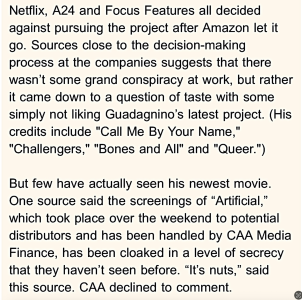
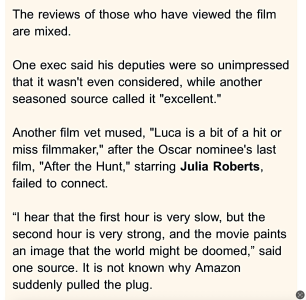
  • Fearful of Sorkin’s Zuckerberg Whistleblower Drama + Joe Popcorn’s Simplistic Mindset, Amazon Bumps Guadagnino’s “Artificial” Into Early ‘27…No Balls or Passion

    For a while it looked like a pair of fall flicks about odious software tech billionaires (Facebook’s Mark Zuckerberg, Open AI’s Sam Altman) bringing harm to democracy and general western culture might battle each other for award-season prominence as well as box-office bucks.

    But according to a recent, apparently accurate Tatiana Siegel / California Post story, the battle is over before it’s even begun.

    Amazon and Luca Guadagnino’s Artificial, the Altman flick, is throwing in the towel by opting for an early ‘27 release date and thereby surrendering to Aaron Sorkin’s Zuckerberg drama, The Social Reckoning (Sony, 10.6).

    The irony is that Artificial tells a far scarier, much more unsettling saga (i.e., the coming engulfment of everyone and everything by artificial intelligence) than The Social Reckoning, which is based on the 2021 Facebook leak by whistleblower Frances Haugen — a chilling revelation about Zuckerberg’s willingness to undermine democracy, albeit several years ago.

    Sorkin’s film is basically an urgent, presumably gripping, looking-back drama that unfolded during the Covid era while Guadagnino’s is a looking-forward, “whoa, mama”, cautionary tale that’s happening right effing now.

    And yet Amazon, it seems, is candy-assing out because they believe that Joe and Jane Popcorn are too lazy-brained to grasp the ominous implications of the Altman drama.

    That plus a suspicion that Joe and Jane won’t want to grapple with two dramas about billionaire big-tech bad guys during the same season. Please…too challenging!

    Obviously these are two different subjects and a hell of a double bill, but Amazon doesn’t want to go up against Sony’s Sorkin saga, which Joe and Jane will presumably feel more responsive to given the link to 2010’s The Social Network, the grade-A Sorkin-scripted Zuckerberg drama that David Fincher directed.


  • Is Patrick Wilson Too Hot To Be “Married” to Amy Adams, So To Speak?

    Wilson is almost exactly the same age as Adams (both born in the early 70s), but he looks leaner, trimmer, more tuned-up.

    You know what would have been really interesting? Javier Bardem as the protective husband and Wilson as the deranged Max Cady. Casting against type always adds an extra layer of energy.


  • Warts-and-All “Devils” in Cannes?

    Maybe, maybe not. I’d like to attend but we’ll see.

    I’ve seen incomplete versions of Ken Russell‘s The Devils many times. It’s one of the most scalding portraits of religious bigotry and sadistic governmental cruelty ever created, and is quite the vicious masterwork, quite the meal.

    Lo and behold, the allegedly complete, 114-minute, warts-and-all version will screen in Cannes next week.

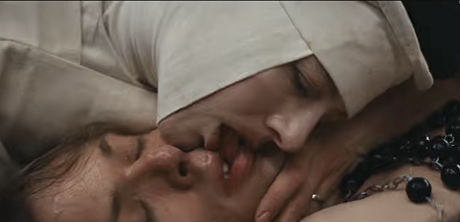
    I’ve sunk my heart and soul into this film time and again. I can recite portions of the dialogue in some scenes. I’ve seen a clip from the sex-crazed humping nuns scene, although I haven’t seen the scene in which Vanessa Redgrave’s wacko nun sexually pleasures herself with one of Oliver Reed’s burnt leg bones.

    I’d naturally like to catch it in a grand final form, but the inclusion of these scenes won’t significantly change the overall. Plus Warner Bros.’s Clockwork will screen it theatrically in this country next October. Plus the Salle Bunuel is a fairly small theatre and everyone will want to get in…ooh!…ooh!…get there early!


  • HE to Larry Kasdan: Have You Allowed Criterion Lizards to Teal “Body Heat”?

    Criterion’s 4K digital restoration of Body Heat, supervised by editor Carol Littleton and approved by director Lawrence Kasdan, pops on 5.19.26.

    If they’ve tealed this thing, there will be hell to pay…that’s all I’m going to say. Body Heat is all sweaty colors…hazy sunlight, amber-lighted bars and street lights.

    William Hurt‘s Ned Racine seems to be making it with an Elizabeth Short/Black Dahlia version of Kathleen Turner‘s Maddy Walker…severed in half, I mean.

    Hurt never so much as looks at a gun in Kasdan’s film, much less picks one up.

    Unnecessary alarm: DVD Beaver Gary W. Tooze has reviewed the Criterion 4K and is not saying there’s any kind of teal problem.


  • Sleep Soundly No More

    Cannes Film Festival press ticket reservations have to made exactly on time or you’ll get shut out. If you’re five or ten minutes late, you’re probably fucked.

    The first reservation window begins on Friday, 5.8, at 9 am (Paris time), or 3 am in New York and 12 midnight in Los Angeles. Repeating: the keyboard ordeal starts in the wee hours tomorrow night…to bed by midnight, and then wake up 2 hours and 45 minutes later and punch in what you want to see. And then crash again.